I Tore Out the Renderer. Again.
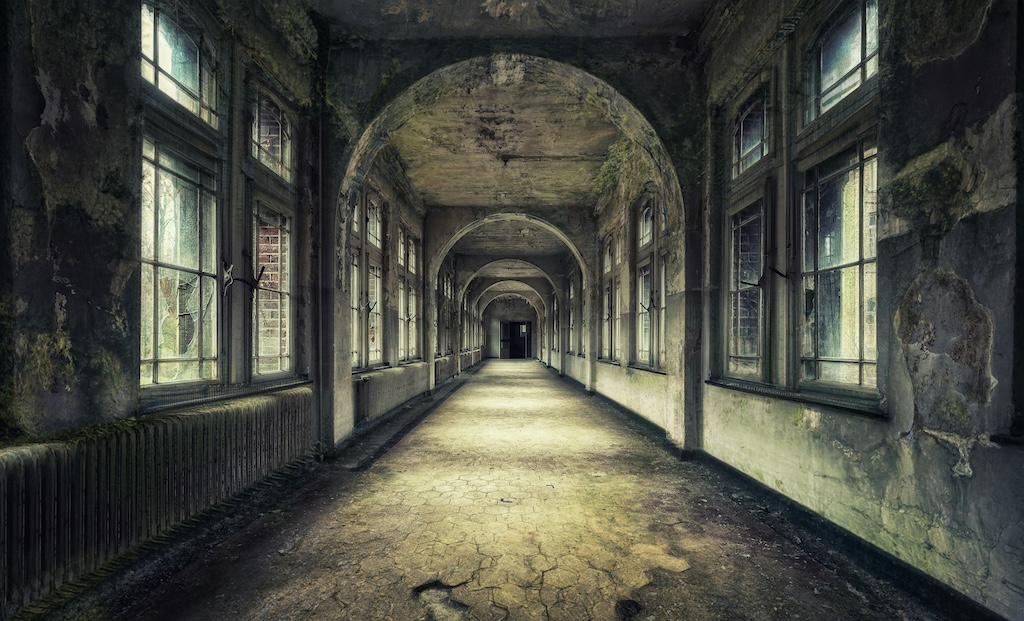
Photo by Peter Herrmann on Unsplash
In the post about my first game, Strataris, I confessed to one of those decisions that cost me weeks: I tore out a renderer I was genuinely pleased with — the old Voxel Space terrain trick — and rebuilt the entire world as a proper 3D triangle mesh, because I wanted to be able to bank and roll and fly properly. It was painful and it was right.
I’m making a second game now. And reader, I did it again.
A different shape of problem
The first game was about flying over a world. The next one is about being inside one — on foot, down through a tight, occupied place, room by room, in the dark, with something in there that wants you. A flying game wants a big open landscape. A game like this wants walls, corners, corridors, the half-second before the adversary steps into the light.
Triangle meshes would have done the job. I’ve got one, working, from last time. The sensible thing — the grown-up thing — would have been to reuse it.
I did not do the sensible thing. When will I learn?
Never, I hope — because the learning is the point. Reusing last year’s maths teaches me nothing; I only learn by building the thing I don’t yet know how to build. That means hours, days, weeks of studying other people’s source code, watching tutorials, falling down Wikipedia holes — and, these days, leaning on AI to sanity-check the maths and catch the mistakes I can’t see.
Maths instead of models
So for this new game I built the whole world out of signed distance fields, and I’ll try to explain that without turning this into a lecture, because I promised myself a long time ago these posts wouldn’t be lectures.
Here is the entire idea. Instead of describing a wall as a list of corners — a model, a mesh, a thing you’d load from a file — you write a tiny function that can answer one question for any point in space: how far are you from the nearest surface? That’s it. That’s the whole description of the world — a function that measures distance.
To draw it, the graphics card fires a ray out through every pixel and just… walks it forward. At each step it asks ‘how far is the nearest surface?’ and takes a step exactly that big, safe in the knowledge it can’t overshoot anything. A few steps later the distance drops to nothing and the ray has found a surface. Do that for a few hundred thousand pixels, sixty times a second, and you have a world.
No vertices. No meshes. No model files. A corridor is an equation. The pipework bolted along the walls is an equation. The rust is an equation. And — this is the part that sold me — so are the monsters. Horrors like the ones that stalk within this new game are not sculpted models; they are a handful of soft blobby shapes blended together with a bit of maths that melts them into one another. Distance fields love organic, wet, bio-mechanical things. They’re terrible at sharp machined edges and wonderful at things that look grown rather than built. For a game about something living in the walls, that’s exactly the right kind of wonderful.
It also means the ‘no asset files’ rule I’m so fond of doesn’t just survive — it gets easier. There’s no model to ship because there was never a model. There’s only code.1
The part where it fought back
I will not pretend this was free. It was a different kind of hard, and in some ways a nastier one.
With triangles, your mistakes are at least visible. Last time I had buildings floating serenely in the sky and, on one memorable evening, the entire planet rendered as a single spike stretching to infinity. Funny, in hindsight. But you could see what was wrong.
Distance-field bugs are sneakier. Get a single sign backwards and the world turns itself inside out — you’re suddenly inside the walls looking at the back of everything. Get the maths for a surface slightly wrong and it shimmers, flickering in and out as the ray can’t quite decide whether it’s hit anything. And there’s a performance cliff waiting the whole time: every extra creature on screen is more maths per pixel per frame, and it is entirely possible to write something correct that also turns your laptop into a small, furious heater. A good chunk of my notes from this stretch are just the word “WHY” at increasing font sizes.
Standing on shoulders of giants, again
None of this is mine. I want to be clear about that, because it matters. This technique is the beating heart of the demoscene — the people who fit entire animated worlds, with lighting and music, into programs kilobytes in size, as a sport. It’s what the wizards on Shadertoy do for fun, conjuring landscapes and creatures out of a screenful of equations. I learned it from people far cleverer than me, who did extraordinary things with it long before I came along and used it to make a monster.
I just keep finding that the harder road teaches me something. You can’t drop in a model, so you have to understand what a wall actually is. And it turns out a wall, in this game, isn’t a picture of a wall. It’s the answer to a question — how far am I from the nearest one? — asked a few hundred thousand times every frame.
I think that’s rather beautiful. I also think it cost me weeks of stress and frustration. Both things are true. That’s the deal.
Update, 2026-09-27. I tore it out again. On 2026-07-29 the signed-distance-field renderer was retired, and Citadel, as this game became, now draws everything with a single conventional rasteriser. The creatures are meshes rather than maths, so there are model files to ship after all, and the footnote about audio being the only asset is out of date too. The announcement tells that part of the story.
Footnotes
-
We’re not entirely asset-free in this new game — the audio came at a price. ↩